Turning a Bland Conference Room Into a Cinematic Interview Setup
White walls. Fluorescent lighting. Four empty corners.
On paper, this was not an ideal interview location.
But this shoot was a perfect reminder that cinematic interviews aren’t about having the perfect room or unlimited gear— they’re about composition, light control, and problem-solving on the fly.
In this breakdown, I’m going to walk through how I searched for a space in a not so ideal building that I turned into a visually compelling two-camera interview using minimal gear, intentional composition, and controlled lighting.
The Location Problem (And the First Fix)
This shoot wasn’t in a school like my usual interview setups—it was inside an office building. My client initially suggested filming in a standard conference room: all white walls, no texture, no depth, and absolutely no visual interest.
Instead of forcing it, I took 15–20 minutes to walk the building. That time mattered.
Eventually, I found a small foyer area tucked between a row of cubicles and a window. It wasn’t glamorous, but it gave me something crucial:
Depth
Separation
Natural lines I could use for composition
Once I found that spot, everything else started falling into place.
Shaping the Light for Control & Mood
As we were setting up for the first interview, I noticed the background was too dark. There was a hallway light in the distance, but the rest of the background fell completely flat—which made the composition feel disconnected.
I had two options:
Turn on the overhead “house lights”
Create my own ambient light
I chose control.
Because I had packed a second light with an Aputure Lantern, I mounted it on a metal light stand and bounced it off the white ceiling. This gave me soft, even ambient light in the background without introducing mixed color temperatures.
Why that mattered:
I didn’t have to match my key light to ugly overheads
I avoided white balance headaches in post
I could expose the subject and background independently
That one decision elevated the entire look.
A Quick Breakdown of Composition
Gear helps—but composition does the heavy lifting.
Camera A (Main Angle)
For my primary shot, I used the ledge of the cubicle and the adjacent wall as an imperfect frame within a frame. It wasn’t symmetrical or clean—and that’s what made it feel organic and cinematic.
Camera B (Secondary Angle)
For the second angle, I used a doorway that opened into another foyer as a perfect frame within a frame. The problem? Office chairs with wheels.
People kept subtly rolling out of frame.
Lesson learned:
For future interviews, I now bring my own stool so framing stays consistent no matter who’s sitting.
The Big Takeaway
Whether it’s:
Leading lines
Frame-within-a-frame
Or intentional negative space
Your goal is the same:
Guide the viewer’s eye naturally to the subject.
You either find composition—or you create it.
Same Location, Totally Different Look
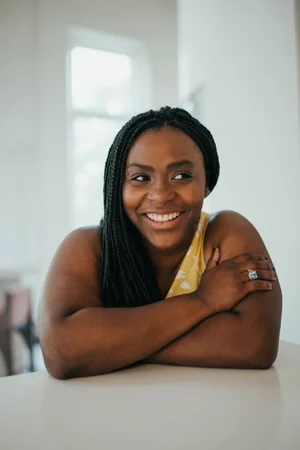
I came back later and filmed another interview in the same exact spot—but reversed.
This time:
The window became my key light
I shot into the corner for depth
I used almost no additional lighting
From nighttime interviews with controlled lighting to daytime interviews using mostly natural light, the takeaway stayed the same:
You can make interviews look professional—and cinematic—when you understand composition and know how to expose your image in any lighting scenario.
Final Thoughts
This shoot is a perfect example of why strong interviews aren’t about perfect locations or massive kits.
They’re about:
Walking the space
Making intentional choices
Controlling light instead of reacting to it
And knowing how to adapt when things aren’t ideal
If you’re filming interviews and just need a solid foundation to make them look better—this approach will get you there.
And if you want more behind-the-scenes breakdowns like this, you know where to find me.
Okay love you byeeeeee.
Full breakdown video here!